The room came first
Berlin techno did not choose its buildings. It took what the East left standing, and the rooms decided what the music had to sound like.
- Subject
- Berlin, Techno
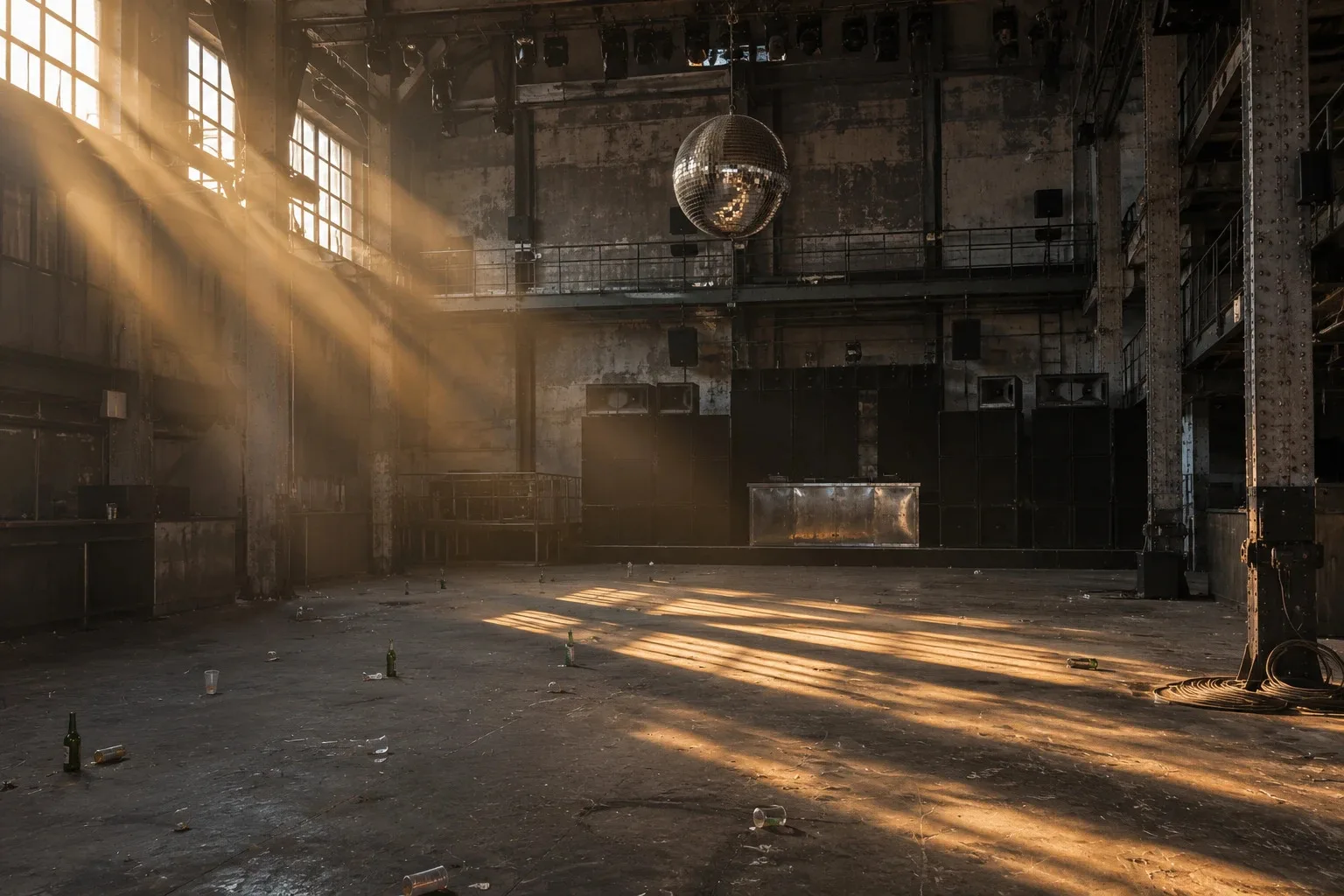
Nothing in this room was built for music. The windows are that high because the machine that stood under them was that high. The floor is concrete because something heavy used to sit on it. Berlin techno did not choose its buildings and could not afford to: it took the ones that were standing empty, and those rooms went on to decide what the music had to sound like.
After 1989 the middle of the city was full of property belonging to a state that had stopped existing. Ownership took years to settle, the buildings were already there, and in many of them the power was still connected. In March 1991 a club opened in the strong room of the bombed Wertheim department store on Leipziger Strasse, inside the strip the Wall had run through, with the old steel deposit boxes still in the walls. It was called Tresor, which is German for the vault, because that is literally what it was.
The pattern repeated for fifteen years. A substation on Wilhelmstrasse became E-Werk. An air raid bunker on Albrechtstrasse became a club and then stopped being one. A combined heat and power station on Am Wriezener Bahnhof, built in the early 1950s to keep East Berlin warm, reopened in 2004 as Berghain. When Tresor lost its vault it moved, in 2007, into another power plant on Koepenicker Strasse. Nobody planned this as an aesthetic. Those were the rooms with height, with thick walls, and with no neighbours to wake.
What a room like that does to sound is not subtle. A hall of bare concrete thirty feet high has a long tail on everything: play something busy in it and the detail turns to mud by the time it reaches the back. What survives is a kick with air after it, slow enough to let the room finish, the middle cleared out, the low end carried by a rig built and tuned for that specific box of air. The thing people mean when they say the Berlin sound is partly just a description of what those buildings would pass.
The clock is also older than the music. West Berlin was exempt from the mandatory closing hour that applied across the rest of West Germany, so the city had grown up without a legal end to the night. That exemption is why a party can start on Saturday at midnight and still be running on Monday morning, and why the light in a picture like this one is daylight. A night that outlasts the night is a different proposition: people stop arriving to go out and start arriving to stay.
The no cameras rule follows from the same thing rather than from mystique. Phone lenses get a sticker at the door. With nobody filming, the floor behaves like a room instead of an audience, and what happens in it does not have to survive being looked at later by people who were not there.
Then the state came back for it. In 2016 a German tax court had to decide whether Berghain was entertainment, taxed at nineteen per cent, or a concert, taxed at seven, and ruled that it was a concert: people go for the music, and the people playing it are performing artists. In 2024 Berlin techno culture was entered on Germany's national list of intangible cultural heritage. Something that began as a party in the unowned ruins of one state is now protected culture of the one that followed, and it is still happening in a power station that was built to heat the first.
Written here, from the published record.