Water in the wrong month
Ladakh gets its water in July and has to sow in April. The fix has no pump, no power and no moving parts: it is a cone, and the shape is the whole machine.
- Subject
- Ladakh, Water, Ice
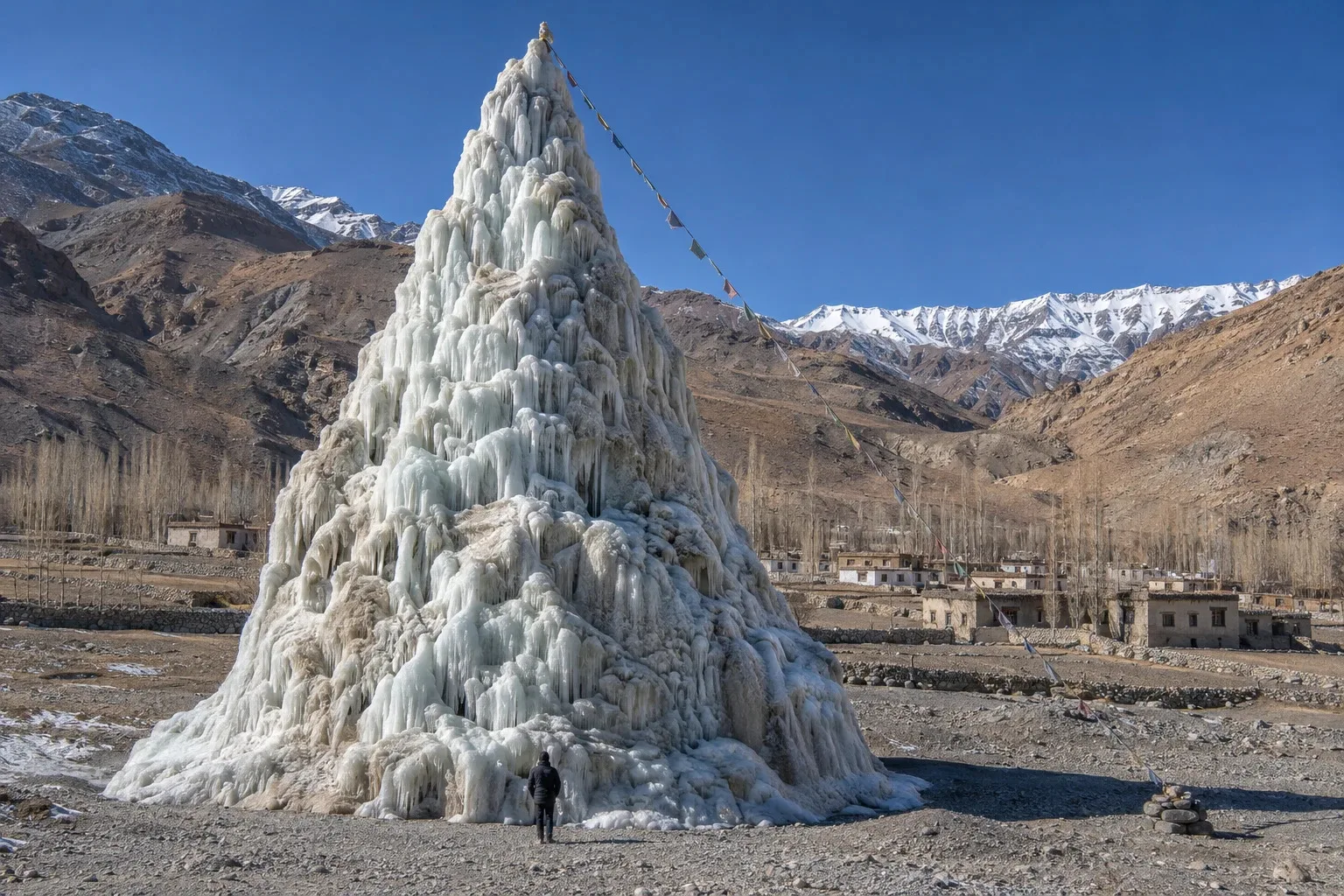
The thing in the picture is not a glacier and nothing natural put it there. It is a cone of ice roughly thirty metres high, built on purpose over a winter, out of water that would otherwise have run away unused. It is a water tank. It has no pump, no power supply and no moving parts, and the reason it works is not the ice. It is the shape.
Ladakh is a cold desert high in the Indian Himalaya, most of its villages between three and four thousand metres. It gets around a hundred millimetres of precipitation a year, less than much of the Sahara, so nothing grows there that is not irrigated. The water comes off snow and ice above the villages, and it arrives in late June and July. Barley and apricots have to go into the ground in April and May. The year has a hole in it: the fields need water two months before the mountain releases any, and as the glaciers retreat the summer flow gets both smaller and less predictable.
Meanwhile the streams keep running all winter under their lid of ice, and all of that water goes straight down into the Indus while the fields sit frozen and empty. The first man to try to catch it was Chewang Norphel, a civil engineer who from the late 1980s diverted winter streams onto shaded terraces high above the villages, held behind low stone walls, where the water froze in thin sheets and sat until spring. They worked. The trouble was that they had to be built high up and in permanent shade to survive, which put them hours from the people who needed them and made every repair an expedition.
The second idea came in 2013, from Sonam Wangchuk, and it is about geometry rather than about ice. A flat sheet of ice presents an enormous area to the spring sun and goes early. The same water piled into a cone presents very little: a cone holds a large volume behind a small surface, its flanks are steep enough that the sun strikes them at a glancing angle instead of square on, and for half of every day one side of it stands in the shadow of the other. So it can be built low down, next to the village, in full sun, and still be there in May.
Building one is almost embarrassingly simple. A pipe is laid from a stream upstream and buried below the depth that freezes. The village sits lower than the intake, so the water arrives under pressure from the height difference alone, with nothing driving it but gravity. At the end the pipe turns upward, the water sprays out into air at twenty or thirty below, and it freezes on the way down. Night after night it grows, layer over layer, which is why the surface ends up looking melted rather than built. The one thing that can kill it is the water stopping inside the pipe, so it is never turned off.
The first full-size one went up at Phyang in the winter of 2015, paid for by a crowdfunding campaign the year before, about twenty metres tall and holding something on the order of a million and a half litres, enough to water several thousand newly planted trees through the spring. It is called a stupa because it looks like one. Ladakh now runs a competition for them every winter and dozens go up, and the design has been copied in Sikkim, Switzerland, Chile and Kyrgyzstan.
What it cannot do is make water. A stupa only moves water from the month that has too much of it to the month that has none, and if the stream does not run in winter there is nothing to spray. Warmer winters make the freezing less reliable, which is to say the thing built to answer a warming climate is itself weakened by it. So this is not a rescue for the glaciers, and nobody involved claims it is. It is a way of staying in a valley while the gap is still bridgeable. Stand next to one in March and you are not standing next to a monument. You are standing next to this year's water, and by June it will be gone.
Written here, from the published record.