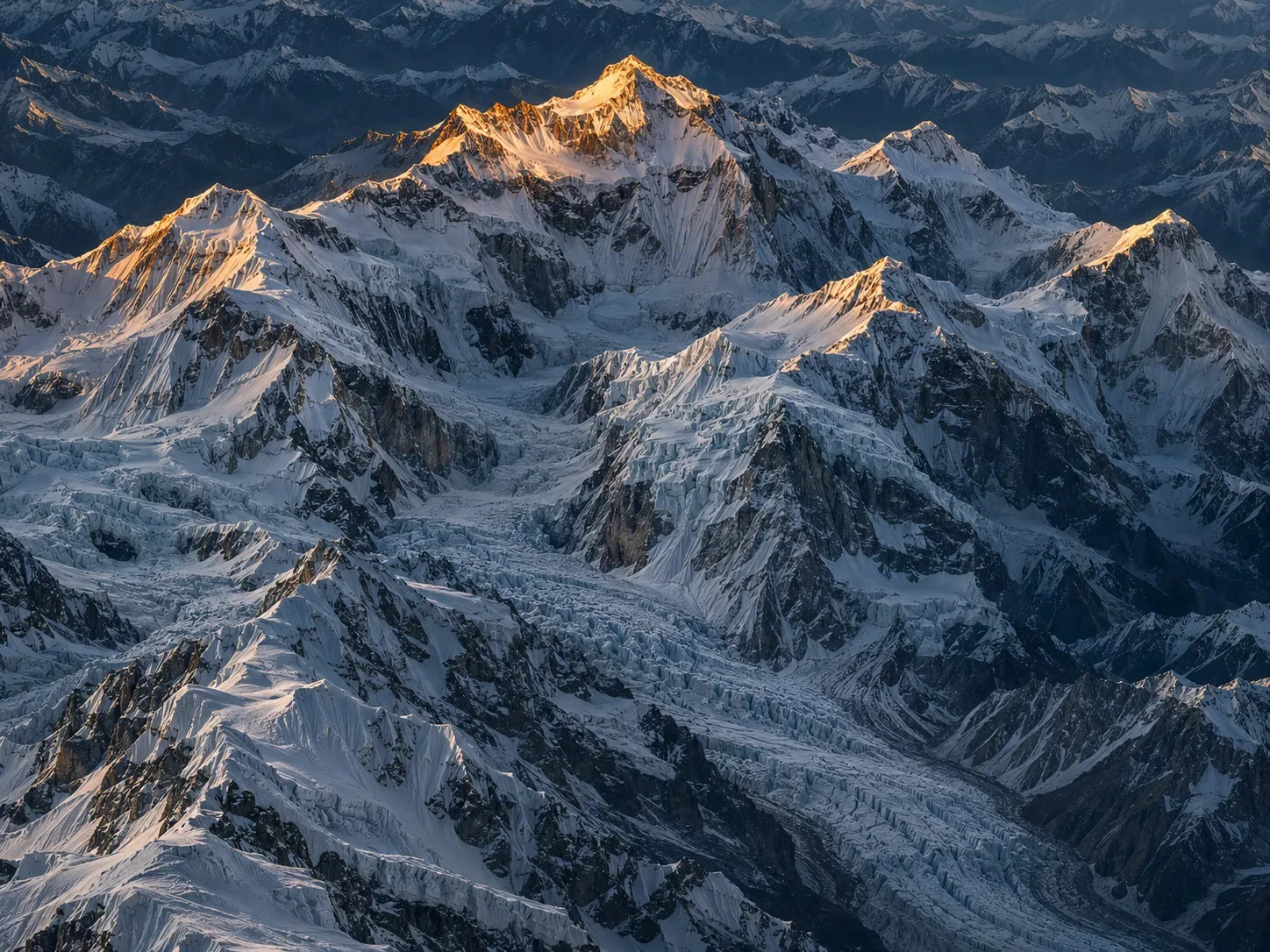
The summit nobody stands on
Kangchenjunga was climbed in 1955, and its highest point has still never been stood on. The men who got there stopped a few feet short, because they had given their word.
- Subject
- Nepal, Sikkim, Promise
Kangchenjunga stands on the border between Nepal and the Indian state of Sikkim, 8,586 metres high, third in the world after Everest and K2. Its name comes from the Tibetan for the five treasuries of the great snow, and the five are not a figure of speech: the massif really does carry five separate summits, and the people living under them have counted and named them for centuries. It was thought to be the highest mountain on earth until the surveys of the 1850s moved it down to third.
It was climbed on 25 May 1955, by a British expedition under Charles Evans. Joe Brown and George Band went up the last stretch together. Norman Hardie and Tony Streather repeated it the following day. All four did the same thing at the top: they stopped a few feet below it, stood on the snow just under the highest point, and came down again.
That was not caution and it was not failure. Before the expedition set out, the Chogyal of Sikkim had asked that the summit itself be left untouched, because for the people on both sides of the mountain it is where a god lives, not a place for men to stand. The expedition gave its word. At the top, with nothing above them and nothing to stop them, they kept it.
Most of the people who have climbed the mountain since have kept it too. Seventy years on, Kangchenjunga is the only eight-thousander whose actual highest point has, by agreement rather than by difficulty, mostly never been stood on. Everest in the same period has been fitted with ropes, queues and a rubbish problem.
The mountain charges for this all the same. It is among the deadliest of the big peaks: the rate usually quoted is roughly one death for every five or six people who reach the top, and while the figures differ depending on who is counting and over what years, nobody puts it low. The weather comes in off the Bay of Bengal without much warning, the ridges are long and there is no quick way down from them, and the slopes above the last camps avalanche.
It has been killing people since long before anyone got up it. In 1905 Aleister Crowley took a party at it from the Yalung side; an avalanche took the Swiss climber Alexis Pache and three local porters, and Crowley, hearing the shouting from his tent below, did not go up to help. The German attempts of 1929, 1930 and 1931 under Paul Bauer took their own dead, porters among them, and turned back short. Twenty-six years of that preceded the four men who walked to the top and then declined to finish the last three steps.
That is the part worth keeping. Not that a mountain was hard, or that it killed people, because every mountain of that size does both. It is that at the one moment when there was nothing left to stop them, four men stopped themselves, and enough of the people who followed them have done the same that the promise still holds. There is not much ground left on earth that is untouched because somebody said it would be.
Written here, from the published record.