The oldest trade route
Plants have been paying fungi for phosphorus since before there were forests. What is under the ground is not one web, and it was never a charity.
- Subject
- Fungi, Soil, Carbon
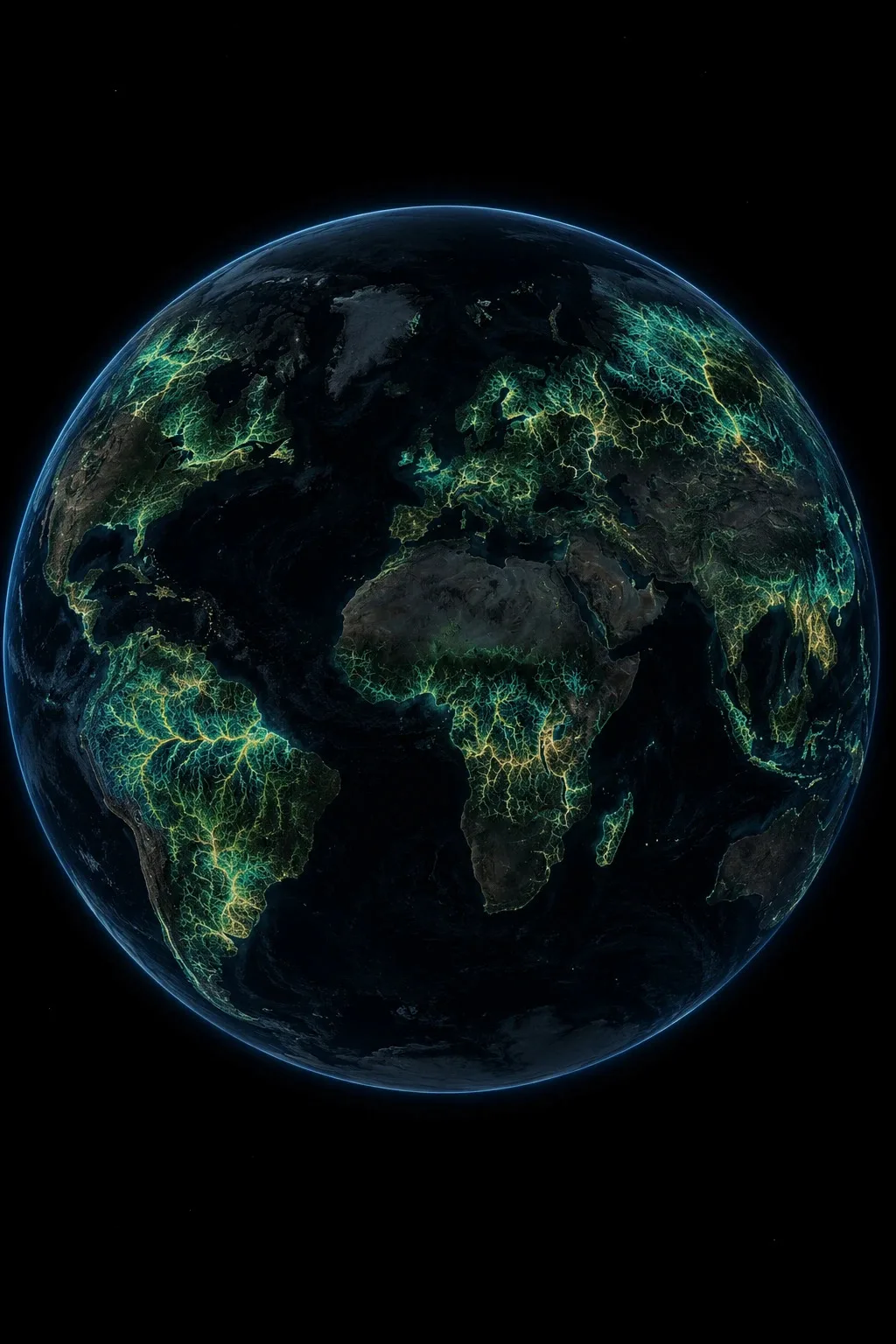
The picture above is a map of where, not a portrait of what. The story most people have heard is that the planet is wrapped in a single connected fungal net, that trees talk through it, and that an old tree uses it to feed the seedlings around her. What is actually under the ground is not one net and it is not a conversation. It is a trading floor. It is around half a billion years old, and it is older than roots.
Start with how much of it there is. Something like nine in ten land plant species run their roots in partnership with mycorrhizal fungi, which is to say that almost every plant anyone has walked past today has a fungus plugged into it doing its mining. A teaspoon of living soil can hold several kilometres of fungal thread. One published estimate puts the total length of mycorrhizal thread in the top ten centimetres of the world's soil at something in the order of four hundred and fifty quadrillion kilometres, roughly half the width of our galaxy. Numbers that size stop carrying meaning, which is why the teaspoon is the better one to keep.
It is also older than most of what we think of as plant anatomy. Plants came out of the water about five hundred million years ago with no roots at all, and the fungus did the job a root would later do. The fossils in the Rhynie chert in Scotland, roughly four hundred million years old, already show fungal structures inside plant tissue, working. Roots arrived afterwards and did not replace the arrangement; they were built around it. Every land plant alive descends from something that could not feed itself on its own.
The exchange itself is specific and it is not generous. The fungus mines phosphorus and nitrogen out of soil particles too small and too scattered for a root to reach, and delivers them. The plant pays in sugar and fat made out of air and light, and the bill is enormous: a 2023 estimate put the carbon that plants push down into mycorrhizal fungi at around thirteen billion tonnes of carbon dioxide equivalent a year, on the order of a third of what fossil fuels put out in the same time. It is also priced. Experiments have watched fungi move phosphorus through themselves towards the roots that are paying better, and plants send more carbon to the fungi that deliver. It behaves like a market, with the behaviours a market produces, hoarding and cheating among them.
The popular version has run a long way ahead of this. The phrase wood wide web comes from a headline in Nature in 1997. In 2023 three researchers went back through the literature in Nature Ecology and Evolution and reported that there is not enough field evidence to say shared networks are widespread in forests, that no peer-reviewed field study has yet shown seedlings benefiting from resources moving through one, and that the citations themselves had drifted, with hopeful readings repeated far more often than the original papers supported. The underground is real and it is doing an enormous amount of work. The nursery is not established.
Where fungal life does reach the scale of the picture above, it is not running a community. In the Malheur National Forest in Oregon a single Armillaria ostoyae covers something like nine and a half square kilometres and is thought to be thousands of years old, the largest organism anyone has measured. It is a root rot. It got that big by growing into trees and killing them, and it is still doing it.
The last thing is the honest one. Around a hundred and fifty thousand fungal species have been described, against estimates of two to four million, and serious attempts to map these networks at a global scale have only been running for a few years. So a glowing web drawn across every continent is a guess, and saying so is the point of putting it at the top of the page. This is the largest biological system on land, it has been running the chemistry of the surface since before there were forests, and we have named perhaps one species in twenty. The picture is not a portrait. It is an admission.
Written here, from the published record.