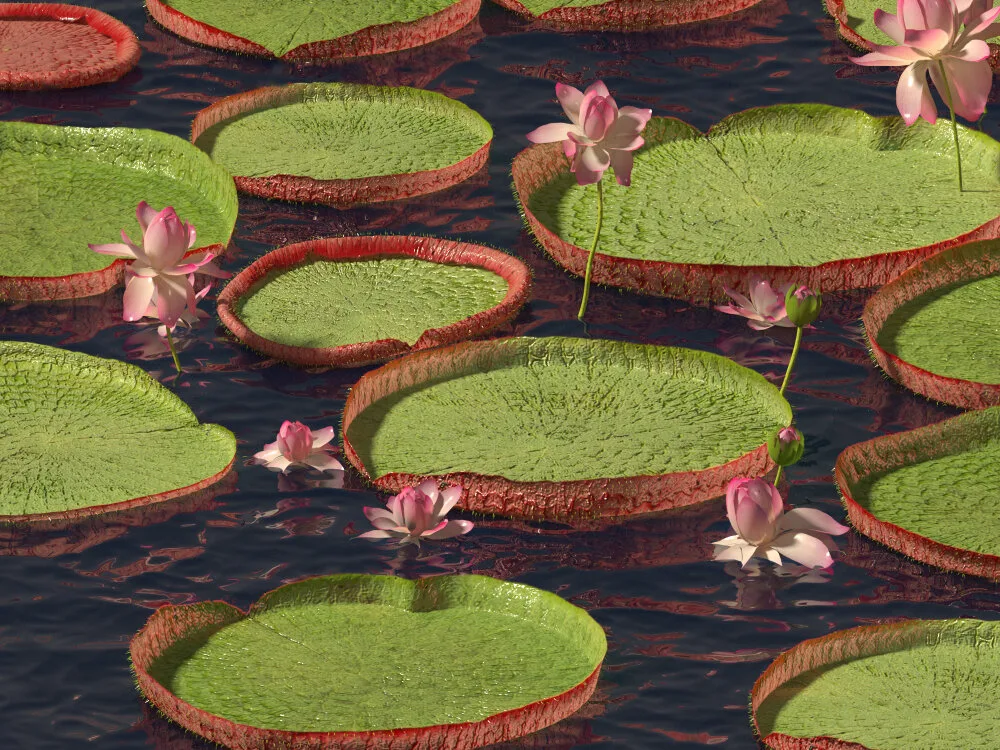
The leaf that taught a building to stand
A plant that fights for the surface of a pond, and the frame under its leaf that put up the first prefabricated building in the world.
- Subject
- Water, Engineering
The giant water lily is not the calm thing it looks like from above. A leaf can run to about three metres across, and the plant grows them fast and crowds the surface with them, because the surface is the whole contest: whatever ends up under a pad gets no light. The upturned rim stops a neighbouring leaf riding over the top of it. The underside is armoured with spines, which deters the fish, and also makes a pad a bad thing for a rival leaf to push against.
Hold that shape in your head, because it is the point of this piece. Underneath, the pad is a frame: thick ribs running out from the centre like spokes, cross-braced between them, with air trapped in the compartments. That is what lets a leaf a few millimetres thick carry a weight spread across it without folding. The plant is not floating. It is engineered to float.
In 1849 Joseph Paxton, head gardener at Chatsworth, got one of the first seedlings to survive in England to flower, in a heated tank he built for it. To show what the leaf would take, he stood his young daughter on one. Then he built a glasshouse for the plant on the logic he had just been looking at: ribs out from the centre, cross-girders between them, the load carried by the frame and the glass doing nothing but keeping the weather out.
Two years later he built the Crystal Palace the same way, and the modern prefabricated building came out of it: a frame of repeated identical parts, shipped in, bolted together, up in months instead of years. Paxton said plainly where the idea came from. Historians have argued ever since about how literally to take him, and that argument is worth having, but the house he built for the lily is still the clearest evidence either way.
The flower has machinery of its own. It opens white at dusk on the first night, warms itself several degrees above the air around it, and puts out a scent of pineapple. Beetles come to the heat and the smell, and the flower closes on them and holds them overnight. On the second evening it opens again, by then turned pink and carrying pollen, and lets them go to fly to the next white flower. Both colours are in the picture above, which means that pond is on its second night.
This is not a plant anyone has finished describing. In 2022 Kew formally separated out a third species, Victoria boliviana, after it had sat in the collection and in gardens for well over a century being taken for one of the other two. The largest leaves in the world, grown in public gardens across half of Europe, and nobody had checked which plant they were looking at.
Written here, from the published record.